I still miss Macromedia Fireworks
Man, I loved that app. It revolutionized design software, and it still doesn’t get credit for how much it shipped first:
- Pixels and paths in one canvas. Bitmap editing and vector drawing together in 1998, when every other tool made you pick a side.
- PNG as the source file. A brilliant hack: the document was a PNG with the editable source inside, so every file was its own preview.
- Live effects. Shadows, glows and bevels that stayed editable on vectors and text. Nothing ever flattened.
- Symbols. Reusable instances with a library, fifteen years before Sketch symbols and Figma components.
- The web-export workflow. Slices, per-slice compression, side-by-side optimize previews. Everyone has this now; Fireworks had it first.
- The property inspector, applied to drawing. Fireworks MX took Dreamweaver’s invention and made it feel native to graphic design.
I was at Google back in the day, and most of the design team used it every day for years. Gmail, Google Maps, Docs, Spreadsheets, Presentations, Sites, and more were all designed in Fireworks.
But then Adobe bought Macromedia and Fireworks was discontinued in 2013. I kept it on my machine as long as I could. There was nothing to replace it with.
Until…
A wild Sketch appears
Sketch came out of nowhere with 2.0 in 2012 and picked up the torch. 1.0 was a little-used, vector-only tool. But 2.0 was a small, fast, native Mac app that was the closest thing Fireworks ever got to a successor. Vector-first but with basic bitmap editing. File-based, no bloat. It won an Apple Design Award that year, and for a good stretch it was where nearly every app interface and icon got drawn.
Sketch earned a credit list of its own, shorter but real:
- Exporting, reinvented. Mark any layer exportable, get @1x and @2x assets in one click. No slices, no Save for Web. Every tool since has copied it; the retina era would have been misery without it.
- Pixel-perfect vectors. Drawing snapped to the real pixel grid, so interface work never landed on half pixels.
- The infinite canvas. Artboards scattered across one endless page, a whole app visible at once. Illustrator had artboards first; Sketch made them the way apps get designed.
In 2017, Sketch was the primary tool for about 70% of interface designers. But a year earlier a little-known browser app had launched that was about to change the game.
Figma enters the chat
Figma launched in 2016. It ran in the browser. A whole team could work in the same file at once. And it was cheap! App designers especially moved over almost overnight. Design became a team sport, for better and for worse, and Figma was built for exactly that.
The wild part is that an app like that shouldn’t have been possible in a 2016 browser. The web couldn’t render a serious design canvas, so Figma didn’t ask it to. Evan Wallace wrote a rendering engine from scratch in C++: text rasterization, masking, blurs, blend modes, the whole graphics stack. He pointed it straight at the GPU through raw WebGL and used none of the browser’s own drawing machinery. When WebAssembly arrived in 2017, Figma was one of the first serious apps on it and load times dropped 3×. Everyone remembers Figma as the multiplayer company. Under the hood it was a graphics-engine company that happened to run in a tab.
The takeover was total. By 2024, Figma was the primary tool for 82% of interface designers. Sketch, which owned the field seven years earlier, was under 2%.
Today Figma keeps getting more expensive and complicated, and Sketch keeps chasing it. In that chase for design-system and multiplayer parity, Sketch drifted from what made it great. Every recent release has been less reliable for me. I had to make a move.
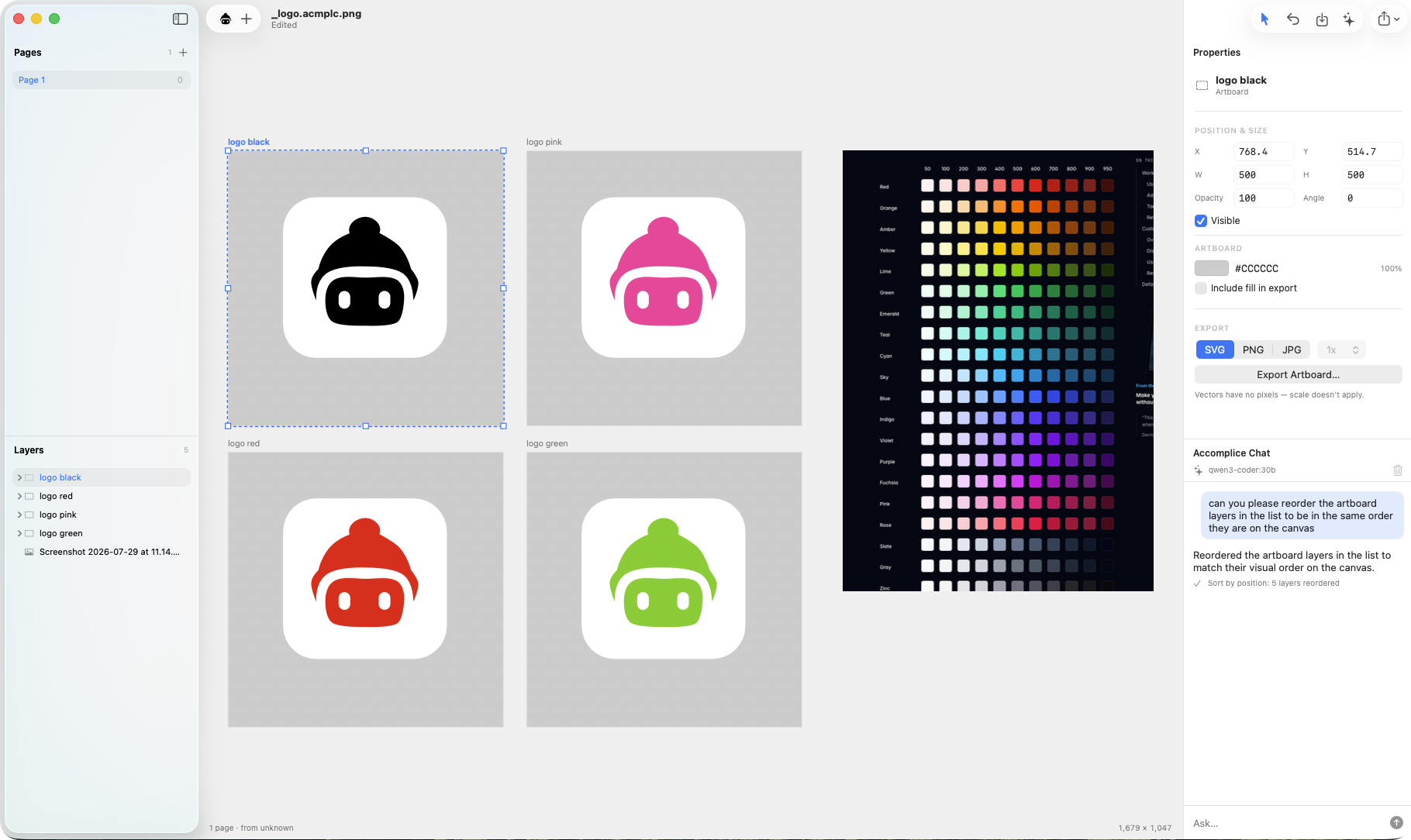
Accomplice is my attempt at a modern day lovechild of Fireworks and Sketch 2.0. Built for one person. Pixels and paths in one canvas. One file on your disk. Native and quick. The gaps between a solo tool and Figma get filled a different way: local AI and Claude Code integration working right beside the canvas, not a platform wrapped around it.
And now… Accomplice
Software is about to get weird. Software as a service is dead. There's no going back.
Figma won't be able to keep charging per seat. Sketch won't be able to keep charging a yearly subscription. Like everybody else in the new world of software we find ourselves in, they’ll have to get creative.
Accomplice is priced with this weird new future in mind. Free and open source. If you want to use the smart features, like vectorizing a bitmap or removing something out of a bitmap, you can use Accomplice credits or bring your own OpenRouter key. Pay nothing for everything else.
Accomplice is the tool I’ve always wanted, just like I've always wanted it, and I use it everyday. Know that if you find a bug I've probably found it too and am working right then on fixing it. For now, features will probably only get added when I need them. But if you do have a bug report or feature request, let me know.
And if you'd rather have Claude build you your own version, no problem. Accomplice is open source. Use it as a starting point or a reference and go nuts. Fork it and let me know what you build.
Happy creating!